


$154.7 billion plan boosts AI adoption, family support, and enterprise growth
Singapore is recalibrating for a fractured global landscape with its largest-ever national budget. The $154.7 billion spending plan unveiled on Feb 12 signals a strategic shift toward artificial intelligence leadership, workforce resilience, and stronger social support.
Record Budget Amid Global Uncertainty
Prime Minister and Finance Minister Lawrence Wong introduced a record $154.7 billion Budget, $11.4 billion higher than the previous financial year. Government spending now accounts for 18.4 percent of gross domestic product and is projected to approach 20 percent by 2030.
Despite achieving stronger-than-expected growth of 5 percent in 2025, Singapore anticipates more moderate expansion of 2 to 4 percent in 2026. An $8.5 billion surplus is forecast for the 2026 financial year, lower than the $15.1 billion surplus in 2025. PM Wong emphasized that sound public finances allow Singapore to invest decisively while maintaining a balanced Budget over the medium term.
National Push To Harness Artificial Intelligence
A major pillar of Budget 2026 is artificial intelligence. PM Wong announced he will chair a new National AI Council to drive strategy and coordinate national efforts. The goal is to ensure Singapore deploys AI effectively, responsibly, and at speed.
The Government will incentivize companies to accelerate AI transformation and expand AI literacy in institutes of higher learning. Singaporeans will be encouraged to acquire AI-related skills through SkillsFuture courses and other training pathways. While acknowledging concerns about job displacement and rapid technological change, PM Wong stressed that Singapore must invest in AI deliberately and with discipline to secure long-term competitiveness.
Strengthening Enterprise And Global Expansion
To help firms navigate an uncertain world, the Government will enhance schemes that support overseas expansion, flexible financing, and capital-intensive ventures. The aim is to help Singapore companies venture abroad and tap new markets.
Domestically, investments will be focused on key growth clusters such as semiconductors, aerospace, and biomedical sciences. PM Wong underscored that investments must remain disciplined and strategic, directed toward areas where Singapore has clear strengths and where policy intervention can make a tangible difference.
Updating Foreign Worker And Wage Policies
Budget 2026 also includes adjustments to foreign worker policies. Minimum qualifying salaries for skilled foreign workers and levies for basic-skilled workers in certain sectors will be increased. The move reinforces the principle that Singaporeans remain at the center of the workforce while the economy stays open to global talent.
Complementing these updates are enhancements to schemes supporting lower-wage and mid-career workers. These include wage increases and expanded training allowances, ensuring that workforce transformation does not leave local employees behind.
Expanded Support For Families And Retirement
Families will receive another $500 in Child LifeSG Credits for each Singaporean child aged 12 and below. Income thresholds for means-tested pre-school subsidies and student care fee assistance will also be raised to ease cost pressures.
To strengthen retirement adequacy, the Government will provide Central Provident Fund top-ups of up to $1,500 for eligible Singaporeans aged 50 and above who have not met the Basic Retirement Sum. A new low-fee investment option for CPF members willing to take on more risk will also be introduced, with temporary government support to kick-start the scheme.
Additionally, eligible Singaporeans will receive a Cost-of-Living Special Payment, enhanced U-Save rebates for utilities, and $500 in CDC vouchers for all households in January 2027.
Investing In Security And Climate Resilience
Looking ahead, security spending is expected to rise amid a more complex global threat environment. While defense expenditure is projected to remain around 3 percent of GDP, Singapore is prepared to spend more if necessary.
The Government will also continue investing in climate resilience to address long-term environmental risks. PM Wong reiterated his vision of building a “we first” society rooted in solidarity, volunteerism, and collective responsibility.
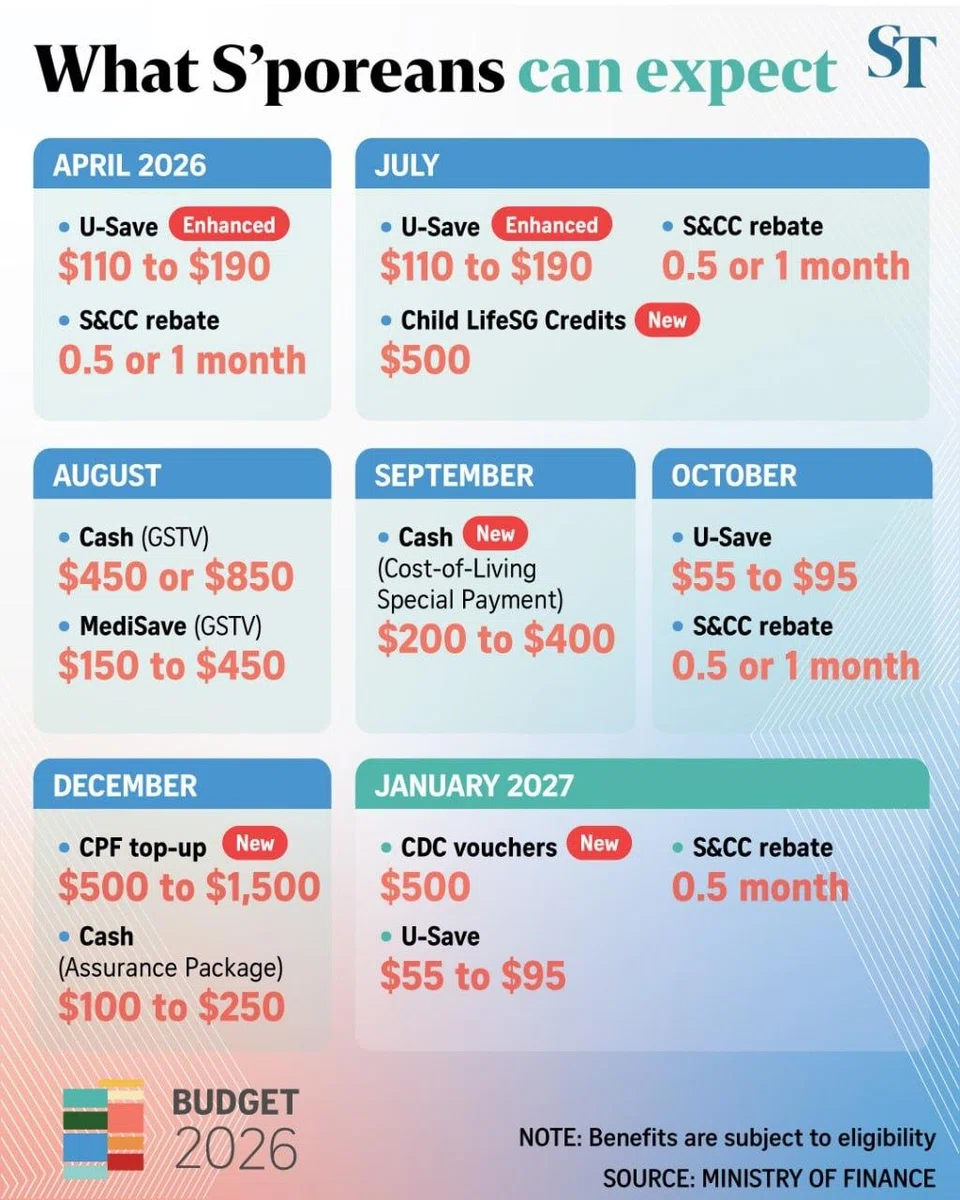
Budget 2026 marks a strategic reset as Singapore navigates technological disruption, geopolitical uncertainty, and rising social expectations. By combining a national AI push with enterprise support and expanded social assistance, the Government aims to secure sustainable growth while reinforcing social cohesion. For Indonesians observing regional economic shifts and Singaporeans preparing for a digital future, the message is clear: resilience will come from disciplined investment, inclusive progress, and shared responsibility.
Sources: Straits Times (2026) , Yahoo! News Singapore (2026)
Keywords: Lawrence Wong, National AI Council, CDC Vouchers, SkillsFuture, Foreign Worker Policy


