


Cancer diagnoses among people under 40 are climbing faster than ever before
What began as a routine sports injury for a young student soon revealed a far more serious reality, reflecting a troubling health trend affecting younger generations worldwide.
A Misdiagnosed Pain That Changed Everything
In January 2024, 25-year-old Joshua Lee initially dismissed his abdominal pain as muscle strain from recreational rock climbing. The psychology undergraduate continued his routine until a severe fall in June worsened the pain, eventually causing him to nearly pass out. Medical scans at Mount Alvernia Hospital later revealed a mass in his abdomen, leading to a stage 3 testicular cancer diagnosis in July 2024 after further tests confirmed the cancer had spread to nearby lymph nodes.
Emotional Toll Beyond the Diagnosis
Despite having no family history of cancer, Lee said he was mentally prepared for the possibility of a serious illness. His greater concern was how the diagnosis would affect his loved ones, particularly his girlfriend, whom he had only begun dating a few months earlier. The sudden diagnosis forced difficult conversations, highlighting the emotional and relational strain young patients often face alongside medical treatment.
Cancer Rising Faster Among Younger Age Groups
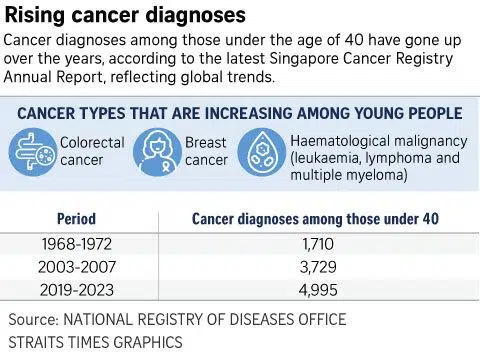
Lee’s case is not isolated. According to the Singapore Cancer Registry’s latest annual report, 4,995 cancer cases were diagnosed among individuals under 40 between 2019 and 2023. This represents a 34 percent increase compared with 3,729 cases recorded between 2003 and 2007. In contrast, between 1968 and 1972, only 1,710 cases were recorded in the same age group.
Doctors Sound the Alarm on Accelerating Trends
Dr. Gloria Chan, a consultant at the National University Cancer Institute, Singapore, noted that while cancer remains more prevalent among older adults, younger age groups are experiencing faster increases in incidence. She said the sharpest rise locally was observed among men aged 30 to 39 and women aged 40 to 49, signaling a shift in traditional cancer demographics.
A Global Pattern, Not Just Local
This trend mirrors global data, according to Dr. Eileen Poon, medical lead at the National Cancer Centre Singapore’s adolescent and young adults oncology program. She cited findings from the Global Burden of Disease study by the Institute for Health Metrics and Evaluation, which reported a 79 percent increase in early-onset cancer worldwide between 1990 and 2019. Individuals under 50 remain the only age group showing sustained increases in cancer incidence since 1995.
International Research Reinforces Concerns
Further supporting this trend, a large-scale U.S. study involving over 500,000 participants, led by researchers from the NUS Yong Loo Lin School of Medicine and published in JAMA Network Open in 2023, found that cancer diagnoses among patients under 50 rose by an average of 0.28 percent annually between 2010 and 2019. Researchers emphasized the need for earlier screening awareness and lifestyle risk evaluation.
The rising incidence of early-onset cancer highlights an urgent need for increased awareness, earlier detection, and stronger public health strategies across Asia and beyond. For both Indonesians and Singaporeans, the trend underscores the importance of listening to warning signs, improving access to diagnostics, and supporting younger patients navigating life-altering diagnoses at an earlier stage of life.
Sources: Straits Times (2026) , Inquirer (2026)
Keywords: Early Onset Cancer, Young Adults Cancer, Singapore Cancer Registry, Testicular Cancer, Global Cancer Trends


