


NUS and NTU warn students against scams promising “guaranteed admission” for up to RM177,000.
Singapore’s top universities — the National University of Singapore (NUS) and Nanyang Technological University (NTU) — have issued strong warnings after discovering China-based agencies offering fraudulent “guaranteed admission” packages to their postgraduate programs, charging unsuspecting applicants as much as 300,000 yuan (RM177,000) per person.
Chinese Agencies Exploit Global University Rankings
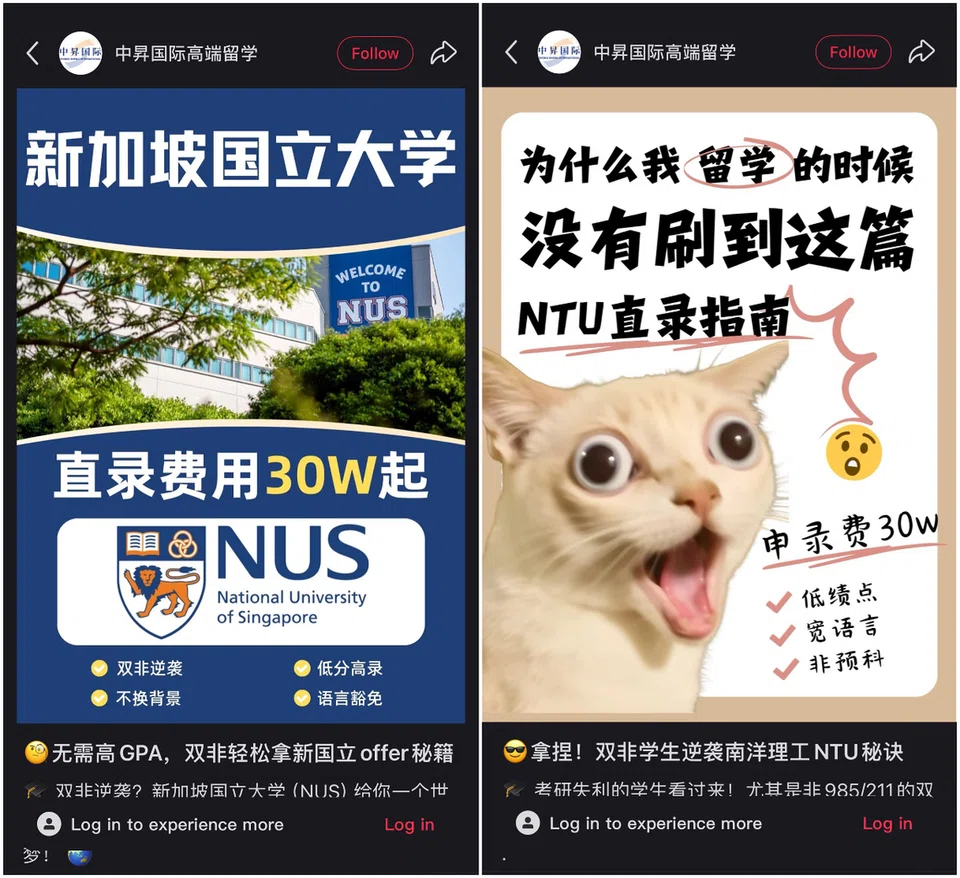
According to The Straits Times, several Chinese study-abroad consultancies have been advertising “fast-track” or “direct” admissions into NUS and NTU through social media platforms like Xiaohongshu. The scams target students with poor grades or low English proficiency, luring them with promises of guaranteed entry into top global universities.
One agency, Zhongsheng International, claimed to help over 1,000 students annually, charging hefty fees beginning at 300,000 yuan (S$55,000). Another firm, Flying Career, falsely claimed to provide professor recommendation letters and assist applicants in passing background checks — both red flags of fraudulent activity.
Universities Denounce Fake “Fast-Track” Admissions
Both universities have categorically denied working with any third-party agencies. NUS emphasized that all applications are reviewed strictly on merit, stating, “There are no ‘guaranteed’, ‘fast track’, or ‘direct’ admission routes to NUS.”
The university also warned that it would revoke student status or degrees obtained through fraudulent means. NTU echoed similar sentiments, confirming that falsified or fabricated applications will be rejected outright, with offenders facing disciplinary action under its academic code of conduct.
Surge in Postgraduate Demand Fuels Scams
NTU noted that applications for its coursework-based postgraduate programs have surged by 30% annually since 2023, reaching around 48,000 applications for 2025. NUS similarly reported “increasingly intense competition” for entry, making its programs attractive targets for admission fraud.
Observers suggest that both universities’ global prestige — NUS ranked 8th and NTU 12th in the QS World University Rankings — has fueled the black market for fake admissions. Scammers exploit applicants’ desperation to secure spots in these elite institutions.
Verification Measures Tightened
In response, both NUS and NTU have strengthened their credential verification processes.
- NUS now requires all international students to present original documents during enrolment and conducts cross-verification with issuing institutions.
- NTU mandates applicants with overseas qualifications to obtain official verification reports from approved agencies such as China Qualifications Verification and CHESICC.
Applications with falsified records are immediately invalidated, and NUS stated that failure to attend document verification may lead to expulsion.
A Growing Challenge for Global Universities
The rise of fake admission schemes reflects broader concerns across Asia’s higher education landscape. As global rankings elevate the prestige of institutions like NUS and NTU, opportunistic agencies are capitalizing on international applicants’ aspirations and anxieties.
Authorities urge prospective students to apply only through official university portals and to remain cautious of any promises of guaranteed admission, particularly from unverified overseas agents.
The fake postgraduate admission scams targeting Singapore’s leading universities highlight a growing threat to academic integrity across Asia. For students in Indonesia, Malaysia, and Singapore, the case serves as a stark reminder: legitimate universities never sell access. As competition for world-class education intensifies, so too must vigilance against fraud masquerading as opportunity.
Sources: Malay Mail (2025) , Straits Times (2025)
Keywords: Fake Admissions, NUS Scam, NTU Fraud, Chinese Agencies, University Admission


