


Worse-than-expected contraction reflects tariff uncertainty, high year-ago base, and falling demand in pharmaceuticals and petrochemicals
Singapore’s key exports contracted more sharply than expected in July, reversing from a strong rebound the month before, as shipments to the United States plunged by more than 40 per cent. The weaker showing underscores the risks facing the Republic’s trade-dependent economy amid tariff uncertainties and softer global demand.
Weaker-Than-Expected Numbers
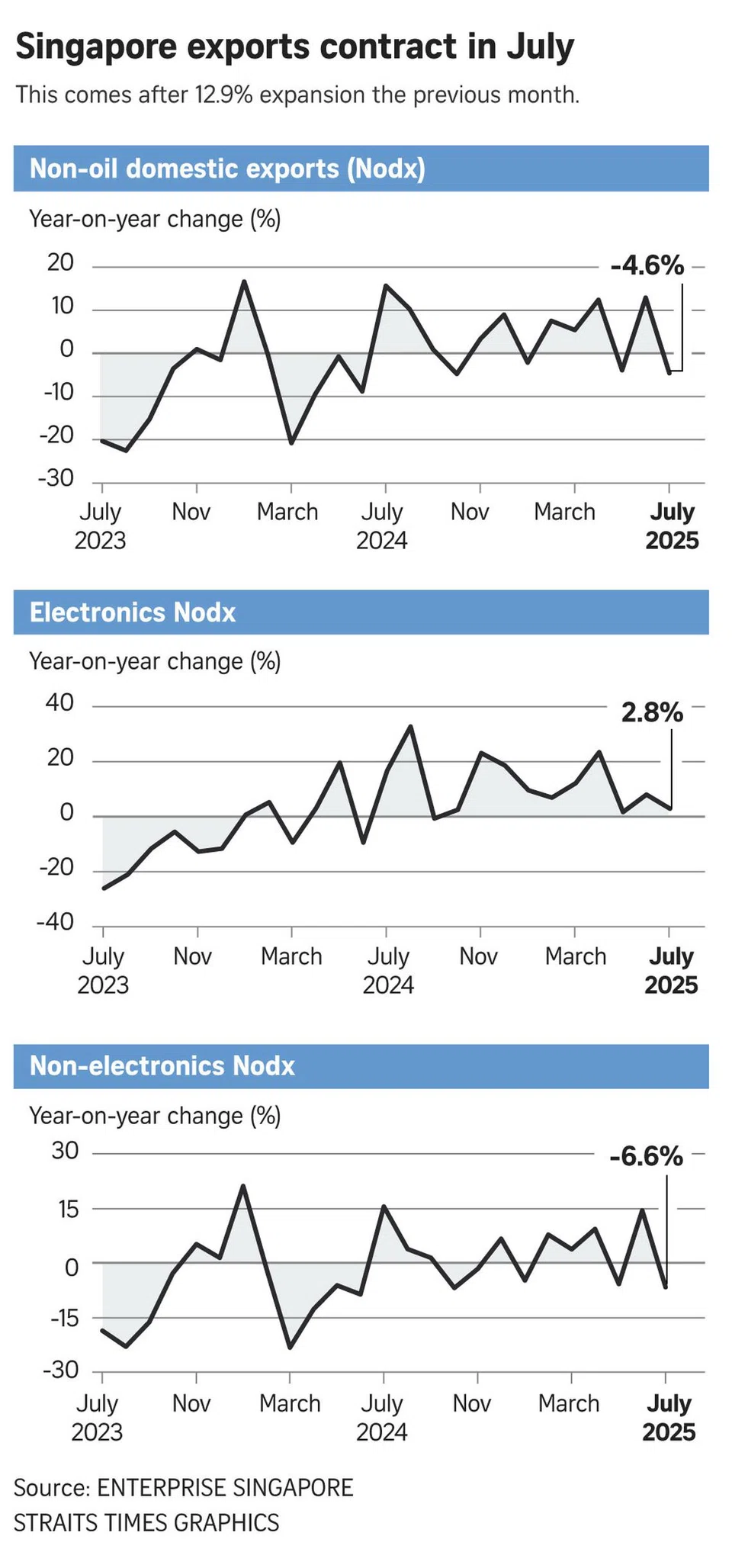
Enterprise Singapore reported on Aug. 18 that non-oil domestic exports (NODX) fell 4.6 per cent year on year in July, compared with private-sector forecasts of a 1 per cent dip. This follows a revised 12.9 per cent surge in June, leaving year-to-date NODX growth at 3.6 per cent — above the official full-year forecast of 1 to 3 per cent.
The July figures mark the steepest drop since October 2024, partly due to the high base from a year earlier.
Electronics Up, Non-Electronics Drag
Electronic exports grew 2.8 per cent, supported by strong shipments of printed circuit boards, personal computers and integrated circuits, although momentum eased from June’s 8 per cent growth.
Non-electronic exports, however, fell 6.6 per cent, reversing the 14.4 per cent expansion a month earlier. The decline was led by pharmaceuticals (-18.9%), petrochemicals (-23.4%), and food preparations (-26.3%).
Market Breakdown
Among Singapore’s top 10 export markets, growth was seen only in Hong Kong, South Korea, Taiwan and the eurozone. Shipments to the US plunged 42.7 per cent year on year, extending June’s decline, while exports to China fell 12.2 per cent and to Indonesia by 32.2 per cent.
Tariffs and Trade Uncertainty
Economists attributed July’s weakness partly to the “payback” effect of earlier front-loading to beat tariff deadlines. US President Donald Trump’s reprieve from reciprocal tariffs ended in August, with possible sector-specific levies on semiconductors and pharmaceuticals looming.
OCBC chief economist Selena Ling warned that while the 10 per cent baseline tariff on Singapore exports is unlikely to change soon, the bigger risk is potential tariffs of up to 100–300 per cent on semiconductors, or as high as 250 per cent on pharmaceuticals. “The impact of 100 per cent semiconductor tariffs is not negligible,” she noted.
Government and Industry Response
Prime Minister Lawrence Wong, in his National Day Rally speech on Aug. 17, cautioned that Singapore must brace for more global trade barriers. “Small and open economies like us will feel the squeeze,” he said.
Maybank economists believe exemptions may be granted to US multinationals like Micron and GlobalFoundries that have committed to US investments. Electronics demand also remains resilient, driven by artificial intelligence, though growth may lose momentum once higher tariffs kick in.
Outlook Ahead
Enterprise Singapore has kept its 2025 exports forecast at 1–3 per cent growth, anticipating weaker performance in the second half of the year. Economists warn that continued softness in pharmaceuticals could outweigh gains in electronics, especially if US tariffs escalate.
July’s trade figures highlight the vulnerability of Singapore’s export sector to shifting tariff policies and slowing demand in key industries. While electronics remain a relative bright spot, sustained declines in non-electronics and tariff threats could weigh heavily on growth in the months ahead.
Sources: The Business Times (2025) , Straits Times (2025)
Keywords: Singapore Exports, NODX July, US Tariffs, Electronics Exports, Pharmaceutical Trade


