


Robust growth in 2024 faces potential challenges from global trade tensions in 2025.
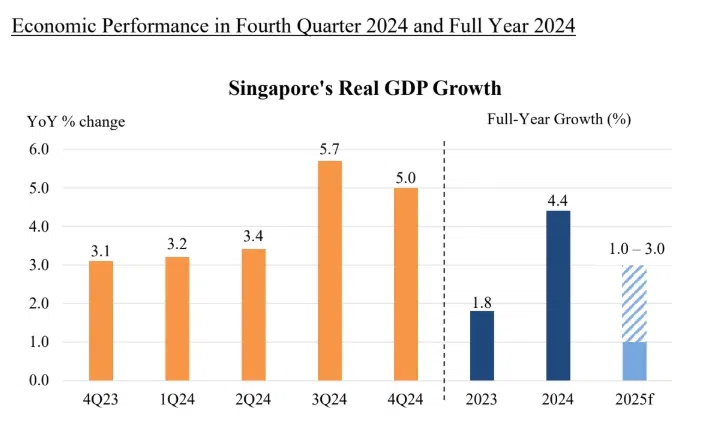
Singapore’s economy concluded 2024 with an impressive 4.4% growth, surpassing earlier estimates and marking a significant rebound from the previous year’s modest expansion. However, as the city-state basks in this economic resurgence, looming global uncertainties threaten to cast a shadow over its 2025 outlook.
In 2024, Singapore’s economy experienced a notable acceleration, achieving a 4.4% growth rate, a substantial increase from the revised 1.8% growth in 2023. This robust performance was driven by significant contributions from key sectors, including manufacturing and services. However, as the nation looks ahead to 2025, concerns arise due to potential global trade frictions and geopolitical tensions that could impact this positive trajectory.
Economic Surge in 2024
The Ministry of Trade and Industry (MTI) reported that Singapore’s Gross Domestic Product (GDP) expanded by 4.4% in 2024, exceeding the advance estimate of 4.0%. This growth was primarily fueled by the manufacturing sector, which saw substantial output expansions in the electronics and transport engineering clusters. The services sector also contributed significantly, with notable performances in wholesale & retail trade and transportation & storage sectors.
Monetary Policy Adjustments
In response to the stronger-than-expected economic performance and easing inflationary pressures, the Monetary Authority of Singapore (MAS) adjusted its policy settings in January 2025. The central bank loosened its currency-based policy, anticipating slower growth and inflation in the coming year. Annual core inflation eased to a three-year low of 1.8% in December 2024, providing room for policy relaxation.
Global Trade Tensions Loom
Despite the domestic economic strength, Singapore remains vulnerable to external shocks. The MTI highlighted significant uncertainties in the global economy, particularly concerning trade frictions and ongoing geopolitical conflicts. These issues could lead to higher production costs and disrupt supply chains, posing risks to Singapore’s trade-dependent economy. The ministry maintained its GDP growth forecast for 2025 at 1.0% to 3.0%, reflecting caution amid these external challenges.
Banking Sector Resilience
Singaporean banks are expected to report higher net profits for the fourth quarter of 2024, driven by robust net interest and fee income. However, analysts warn that escalating trade wars, particularly stemming from U.S. tariff policies, could adversely affect the banking sector in 2025. Potential impacts include increased provisions for bad debts and reduced loan demand due to global uncertainties.
Government’s Proactive Stance
Anticipating potential economic headwinds, the Singaporean government is preparing an expansionary budget focusing on cost-of-living support, housing, and employment initiatives. Economists predict a fiscal deficit ranging between S$3.8 billion to S$6 billion, aimed at cushioning the populace against external economic shocks. Prime Minister and Finance Minister Lawrence Wong is expected to announce measures that address both immediate concerns and long-term economic resilience.
Singapore’s impressive economic performance in 2024 underscores its robust economic fundamentals and effective policy frameworks. However, the nation must remain vigilant as it navigates the complexities of the global economic landscape in 2025. For Singaporeans and international stakeholders, understanding these dynamics is crucial for informed decision-making in the year ahead.
Sources: Tempo (2025), Reuters (2025)
Keywords: Singapore Economy, Economic Growth, Global Trade, Monetary Policy, 2025 Forecast


