


Venezuela Oil, Global Oversupply, and the Brutal Reality Behind the $55 Barrel Era
The world’s most volatile commodity has once again returned to the epicenter of a geopolitical earthquake. As the early weeks of 2026 unfold, oil—Black Gold—continues to prove that in the high-stakes contest of nations, energy remains the ultimate currency of power. A profound paradox now grips the global market: the countries sitting atop the largest reserves are no longer the ones controlling the price, while a looming supply glut threatens to destabilize petro-empires that once held the global economy hostage.
This is a story of Venezuela oil, hidden wealth, brutal power, and an economic shockwave that will soon reach your wallet.
The Great Reserve Deception: Who Really Controls the Oil?
The question of who “owns” oil is not merely geological—it is political, institutional, and, ultimately, coercive. On paper, the world’s largest proven reserves belong not to Saudi Arabia, but to Venezuela. Venezuela oil reserves stand at an extraordinary 303.2 billion barrels, surpassing Saudi Arabia’s 267.2 billion barrels and Iran’s 208.6 billion barrels by a wide margin.
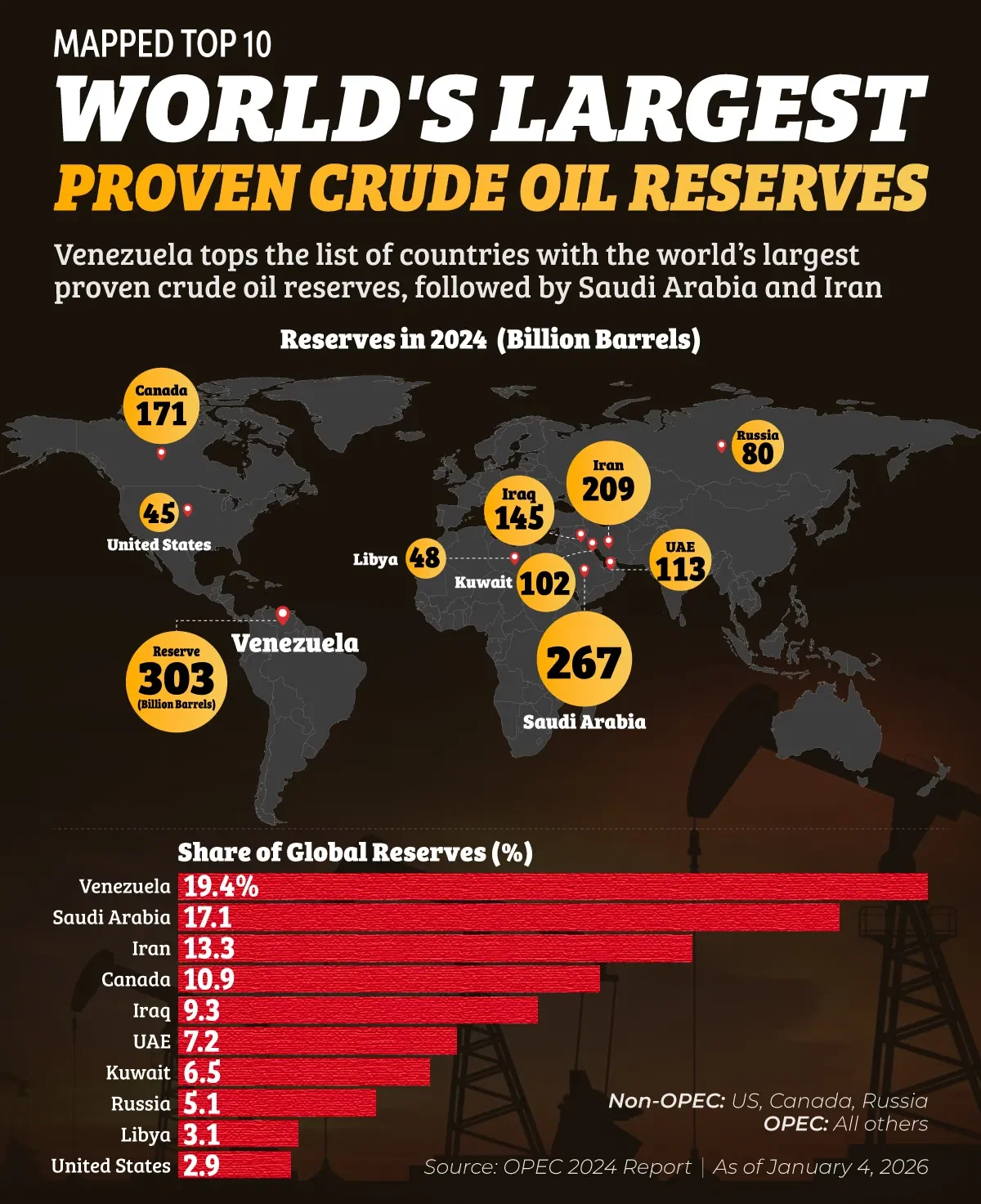
Yet Venezuela oil remains a cautionary tale. This vast subterranean wealth is largely inaccessible, trapped beneath political fragmentation, sanctions, and infrastructural decay. Ownership, it turns out, is conditional. Geopolitical stability—not raw abundance—is the true measure of control.
Oil remains the backbone of the modern state. Countries seek to own oil because it delivers unparalleled leverage in trade negotiations, fiscal stability, and international diplomacy. But reserves alone do not move markets. That power belongs to producers.
Production Power: Why the United States Sets the Tempo
Here, the narrative flips decisively. The United States, powered by its shale and fracking revolution, stands as the undisputed production king. In 2025, the US pumped approximately 20.1 million barrels per day, dwarfing competitors and reshaping global supply dynamics.
This distinction matters. Production capacity and political will outweigh geological endowment. Alongside Saudi Arabia and Russia, the US forms the “Big Three” producers whose collective output dictates market direction. While Venezuela oil dominates reserve rankings, it is the Big Three’s daily production decisions that define prices, trade flows, and global inflation.
The 2025 Price Crash and the $55 Barrel Forecast
The year 2025 delivered a rude awakening for oil bulls. Despite wars, sanctions, and flashpoints across the Middle East and Eastern Europe, oil prices collapsed under the weight of relentless oversupply. The market’s brutal logic prevailed: supply exceeded demand.
Brent crude averaged around USD 68.91 per barrel in 2025 (approximately SGD 93 per barrel). In 2026, forecasts point lower still. Analysts now project Brent to average between USD 55 and USD 61 per barrel (roughly SGD 74–82), a dramatic recalibration driven by a deepening global oil glut.

This is not an abstract shift. For consumers, price volatility translates directly into purchasing power. A monthly fuel saving of 1,000,000 IDR now equates to approximately SGD 83—real money that ripples through household budgets, travel decisions, and discretionary spending. This is why the oil market matters far beyond trading desks.
The Unseen Demand: Why Oil Still Rules Everything
Despite the energy transition, oil’s grip on modern life remains firm. Demand growth is no longer driven primarily by cars, but by chemistry. In 2026, more than 60% of incremental oil demand is expected to come from petrochemical feedstocks.
Oil is the irreplaceable input for plastics, fertilizers that sustain global food systems, and pharmaceuticals that underpin modern healthcare. No renewable substitute yet matches its scale, flexibility, or cost.
Oil also remains the master key to global mobility. Kerosene—derived from crude—accounts for nearly 9% of every barrel. As prices fall, jet fuel follows, lowering operating costs for airlines and opening the door to cheaper long-haul travel. For international visitors, especially to Southeast Asia, this translates into more accessible airfares and revitalized tourism corridors.
Oil is not merely fuel. It is the unseen hand shaping the price of food, flights, medicine, and the smartphone in your pocket.
The Geopolitical Chessboard: Venezuela Oil, Sanctions, and Control
The strategic desire to own oil is inseparable from the projection of power. Few examples illustrate this better than Venezuela oil. In January 2026, reports of Nicolás Maduro’s capture in Caracas sent shockwaves through energy markets, as the United States moved to exert de facto control over Venezuelan oil assets. As deVere Group CEO Nigel Green observed, this development effectively transforms Venezuela oil into conditional supply—particularly for Asian buyers—stripping it of its value as a diversification hedge. Oil, once again, has been weaponized.

This reality defines the modern energy order. It is not enough to possess oil reserves; nations must also command institutional durability, political alignment, and sanction-proof logistics. OPEC+ production discipline, sanctions on Russia and Iran, and Washington’s strategic use of US output now shape the global energy map far more than geology alone.
Asia’s Advantage and the Traveler’s Windfall
The implications of this shifting oil order are immediate and profound. Asia remains the engine of global demand growth, and lower oil prices in 2026 offer a critical reprieve for import-dependent economies across Southeast Asia. Cheaper energy eases inflation, supports domestic consumption, and gives central banks room to loosen monetary policy.
For international travelers, falling jet fuel costs promise a rare windfall: more affordable long-haul flights and renewed momentum for tourism across the region. The energy transition is real. Countries such as Indonesia and Vietnam are accelerating investments in renewables. Yet the uncomfortable truth remains: oil—especially Venezuela oil and US shale—will continue to dominate the immediate future as the world’s most powerful, flexible, and politically charged fuel.
To understand how these forces intersect with global economics, geopolitics, and everyday life, visit our homepage—where we continue to track the stories shaping the world’s next energy chapter.
Sources:
[1] Oil Market Report – December 2025
[2] ENERGYAll of the World’s Oil Reserves by Country, in One Visualization
[3] Here are the countries with the most oil reserves, and where Venezuela ranks
[4] Oil Production by Country 2025
[5] Crude oil prices fell in 2025 amid oversupply
[6] Oil prices forecast to ease in 2026 under pressure from ample supply
[7] Analysis and forecast to 2030
[8] What’s In A Crude Oil Barrel? A Breakdown Of Crude Oil Refined Products
[9] Trump says US is taking control of Venezuela’s oil reserves. Here’s what it means
[10] What US influence over Venezuelan oil really means for Asia
[11] Economic Outlook Asia-Pacific Q1 2026: Signs Of Relief
Keywords: Venezuela Oil Global Power, Venezuela Oil Price Paradox, Venezuela Oil Market Control, Venezuela Oil Geopolitical Strategy, Venezuela Oil Reserves Reality, Venezuela Oil Supply Glut, Venezuela Oil Sanctions Impact, Venezuela Oil Asian Demand, Venezuela Oil Price Forecast, Venezuela Oil Energy Politics, Venezuela Oil Economic Leverage, Venezuela Oil Global Trade, Venezuela Oil Power Shift, Venezuela Oil Strategic Asset, Venezuela Oil Market Dynamics


