


As birth rates fall and loneliness rises, more South Koreans are finding work in the business of death — from funeral training to cleaning homes of the deceased.
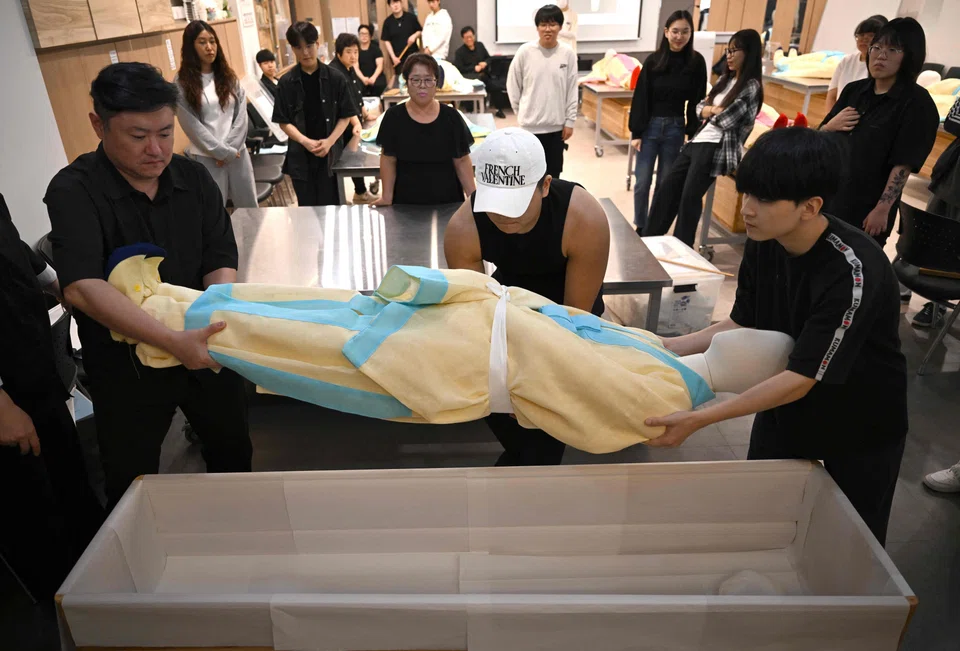
In Busan, South Korea, rows of coffins line a university classroom — not for the dead, but for students training to become funeral directors. As the nation faces rapid ageing and soaring loneliness, death has quietly become one of South Korea’s fastest-growing industries.
A New Generation of Funeral Directors
At the Busan Institute of Science and Technology, young students learn to prepare bodies for their final farewell. Using mannequins, they practice draping traditional Korean funeral cloths — treating each one with reverence and care.
“For our ageing society, this work will only grow in demand,” said Jang Jin-yeong, a 27-year-old funeral administration student. Another student, Im Sae-jin, 23, was inspired to join the field after witnessing the dignity and compassion shown at his grandmother’s funeral.
The Rise of “Lonely Deaths”
Beyond funeral homes, another somber profession has emerged — cleaners of the deceased. With 42 percent of South Korean households now single-person, many die alone, unnoticed for days or even months.
Former musician Cho Eun-seok, 47, now runs a business cleaning the homes of those who died alone. “Their homes are like their portraits,” he said. “You can see their stories in every object left behind — unopened gifts, old bottles, and dusty memories.”
A Dark Reality of Isolation
South Korea has the highest suicide rate among developed nations, and many “lonely deaths” are the result of self-inflicted tragedy. Cho recalled cases where used cars or tiny rented rooms became final resting places. He is now developing a sensor device to detect unattended deaths early, preventing environmental damage from decay and infestation.
“The smell spreads quickly in summer,” Cho said grimly. “When that happens, nothing can be saved.”
Cleaning Beyond the Physical
For some, the work goes beyond cleaning — it’s about preserving memory. Kim Seok-jung, another cleaner, once discovered handwritten songs left behind by a late lyricist and turned them into music for her grieving family.
Cho also shared a haunting story of a high school girl who lived alone in a cramped gosiwon after fleeing domestic violence. She had begged him never to throw away a small box. A year later, after her death, Cho found a hamster living in that box beside her guitar — a symbol of her dream to become a musician. “All I could think was to save the hamster,” he said quietly.
Youth Entering the Business of Death
Even as the industry expands, fear remains part of the job. “No matter how much you prepare, facing a deceased person is frightening,” admitted Im, the funeral student. Yet, industry veterans like Kim Doo-nyeon say more young people are joining. “When people live together, their things remain,” Kim said. “But when someone dies alone, everything must be cleared away.”
South Korea’s demographic crisis — defined by low birth rates, ageing citizens, and rising isolation — has turned death into both a business and a social mirror. For younger generations like Jang, Im, and Cho, confronting mortality has become a way of life — one that reveals not only how South Koreans die, but how they live, alone.
Sources: The Business Times (2025) , Barron’s (2025)
Keywords: South Korea, Ageing Population, Funeral Industry, Lonely Deaths, Demographic Change, Busan


