


Singapore’s inflation hits a four-year low, with core inflation dropping to its lowest rate in nearly four years.
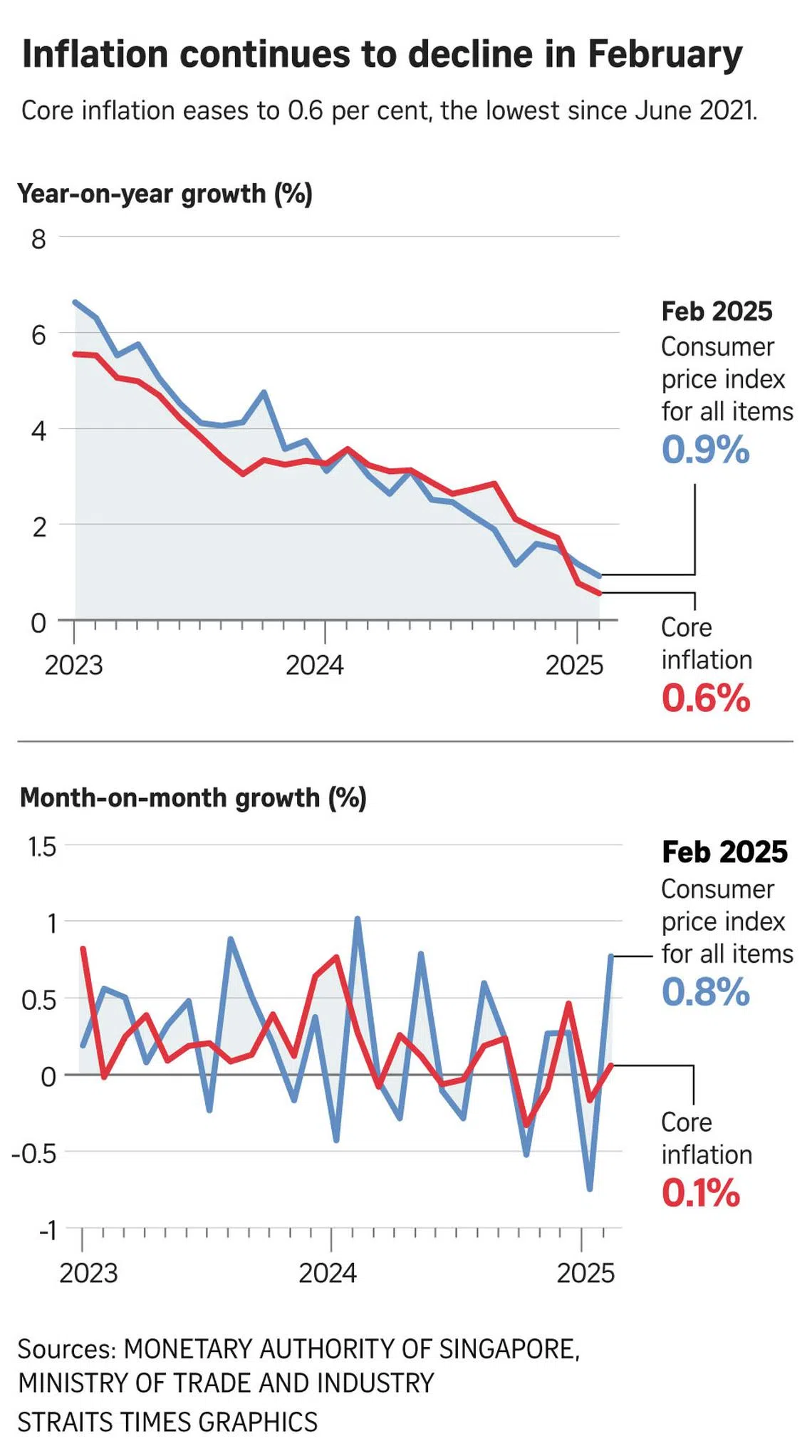
Singapore’s inflation rate eased to its slowest pace in four years, with the consumer price index growing by just 0.9% year-on-year in February 2025. This marks a significant drop from the previous month and aligns with economists’ expectations.
The decline in inflation comes as Singapore’s economy faces slower growth projections, with the Monetary Authority of Singapore (MAS) downgrading its core inflation forecast and GDP growth outlook for 2025.
Core Inflation Hits Four-Year Low
In February 2025, Singapore’s core inflation rate dropped to 0.6%, the lowest it has been in nearly four years. This marks a significant reduction from January’s 0.8% and is lower than the expected 0.7%. Core inflation, which excludes accommodation and private transport costs, has been steadily easing, giving economists reason to speculate that the Monetary Authority of Singapore (MAS) could ease its monetary policy at its next policy review in April 2025.
Downward Trend in Inflation
The country’s overall inflation, represented by the consumer price index, grew by just 0.9% year-on-year in February, down from January’s 1.2%. This marks a continuing trend of easing inflation in Singapore, prompting the MAS to adjust its monetary policies. In January 2025, the MAS loosened its policy for the first time since 2020, noting the faster-than-expected decline in inflation.
MAS Forecasts and Economic Outlook
MAS has forecast that headline inflation will average 1.5% to 2.5% in 2025, down from 2.4% in 2024. The central bank has also revised its core inflation forecast to a lower range of 1%–2%, compared to the 1.5%–2.5% projection made in October 2024. As for economic growth, Singapore’s GDP is expected to expand by just 1%–3% in 2025, a slowdown from the 4.4% growth seen in 2024.
With global economic uncertainties, such as tariff fluctuations outside the U.S., the MAS is likely to err on the side of caution. The economic spillover effects from these uncertainties remain unclear, but with growth risks in mind, economists are watching closely for any changes in MAS’s monetary policy in response to the evolving global landscape.
Impact on Singapore’s Economic Future
As Singapore navigates these slower growth and lower inflation rates, the central bank’s policy decisions will play a crucial role in steering the country’s economy. The current inflationary trend suggests a more stable price environment, but the broader implications on growth remain a concern for the upcoming year.
Singapore’s inflationary slowdown presents a mixed picture for the country’s economy in 2025, as lower inflation could offer stability but also signals slower economic growth. The MAS’s forthcoming policy review in April will likely provide more clarity on the government’s strategy to maintain economic balance.
Sources: CNBC (2025), Reuters (2025)
Keywords: Singapore Inflation, Core Inflation, MAS Policy, Economic Growth


