


Meta enforces stricter identity checks for all advertisers to curb rising scam cases in Singapore.
Singapore’s Ministry of Home Affairs (MHA) has mandated that all Facebook advertisers verify their identities by June 2025, following a 12% increase in scam ads over the past year. This comes as Facebook and Carousell face heightened scrutiny over e-commerce fraud, with Facebook accounting for 37.4% of all online scams in 2024. Meta has now pledged to expand its verification processes, requiring government-issued ID checks for advertisers and extending its facial recognition pilot program to Singapore.
Starting June 2025, all Facebook advertisers in Singapore must verify their identities before launching new ad campaigns. Meta’s Director of Public Policy for Southeast Asia, Rafael Frankel, confirmed that both the payer and beneficiary of each ad must undergo verification, with this information displayed in the Ad Library for public transparency.
The move follows an MHA review from June to December 2024, which found that Facebook scam cases surged despite previous verification measures applied selectively. As a result, Meta must now implement identity checks for all advertisers, rather than just high-risk users.
Facebook Pages & Marketplace Under Scrutiny
Apart from Facebook ads, MHA has also flagged scam activities on Facebook Pages, where fraudulent sellers create pages impersonating businesses. MHA is collaborating with Meta to introduce enhanced verification for Facebook Pages in 2025, initially applying the rules to selected pages before expanding site-wide if scam numbers fail to decline.
Meanwhile, Facebook Marketplace scams fell by 55% in the past year, prompting MHA to hold off on mandatory verification for all sellers. However, the government will continue monitoring fraudulent activities and may impose stricter measures if needed.
Carousell’s Fraud Reduction and Extended Review
Carousell, another platform under review, saw an 11% drop in e-commerce scams but did not meet the “significant decrease” threshold set by MHA. While it avoided immediate mandatory verification for all sellers, MHA extended the assessment period by another six months until June 2025.
Carousell has expressed reluctance to enforce full-scale verification, arguing that it would create barriers for new sellers. Instead, it plans to continue targeted verification, focusing on high-risk transactions based on user reports and scam trends.
The Scale of Singapore’s E-Commerce Scam Crisis
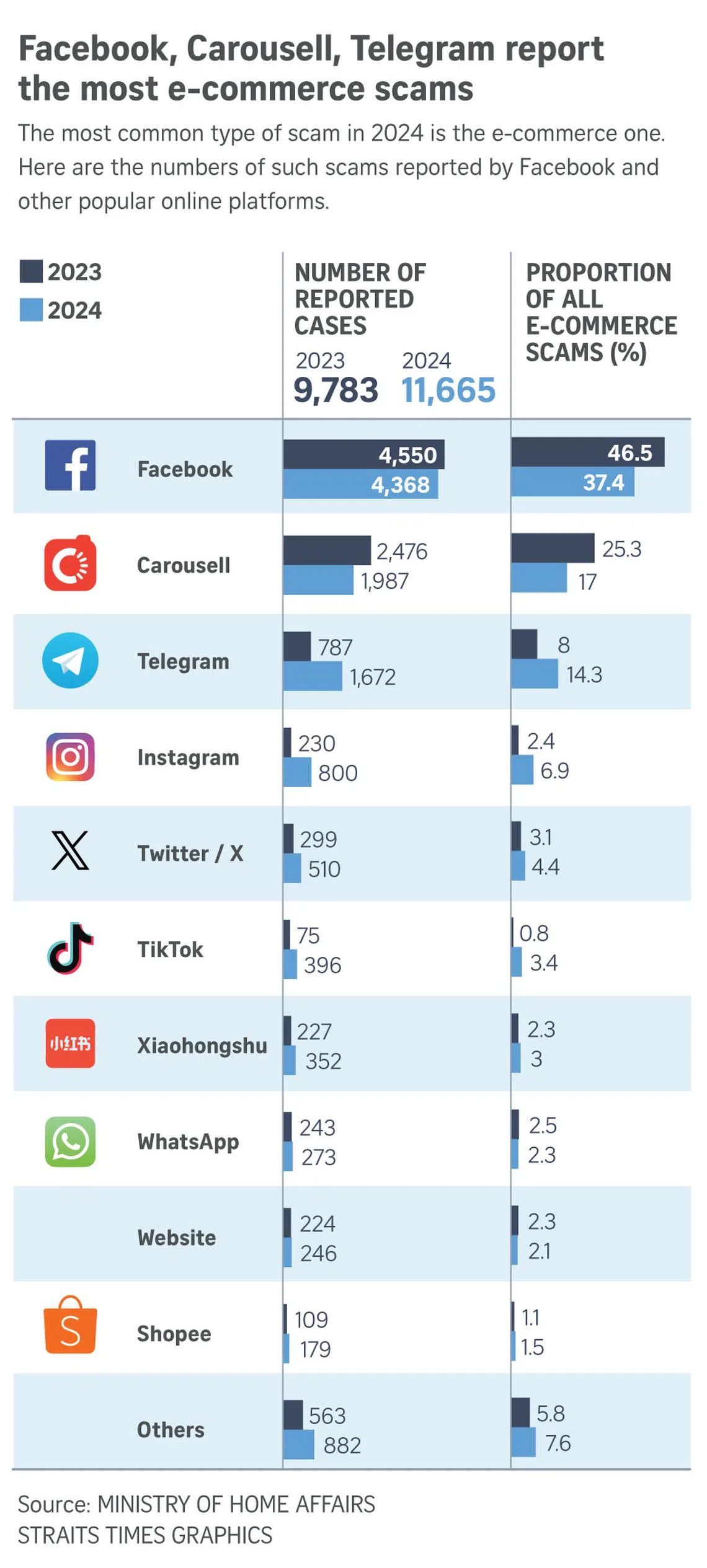
Scams remain a major concern in Singapore, with e-commerce fraud ranking as the most common scam type in 2024. Official data shows:
- 4,368 scams (37.4%) originated from Facebook, making it the most fraud-prone platform.
- 1,987 cases (17%) involved Carousell, placing it second on the list.
- A total of 11,665 e-commerce scams were reported, with victims losing S$17.5 million, marking a sharp rise from S$13.9 million in 2023.
The Online Criminal Harms Act (OCHA), enforced in February 2024, allows the government to penalize tech platforms failing to curb scams, with fines up to S$1 million for non-compliance.
The Facebook and Carousell scam crisis has prompted Singapore to enforce stricter verification rules, aiming to restore public trust in digital marketplaces. With Facebook’s new advertiser verification system, and pending checks on Facebook Pages, the government hopes to curb fraudulent ads and online scams. However, concerns remain over whether these measures are enough, as scammers constantly adapt to evade detection.
As Singapore strengthens its digital fraud prevention, global tech firms may face similar regulations in other markets if these measures prove effective. The battle against online scams is far from over, but stricter enforcement signals a shift toward greater accountability in digital commerce.
Sources: The Straits Times (2025), CNA (2025)
Keywords: Facebook Scams, Meta Verification, Online Safety, Digital Advertising, Social Media Regulation, Scam Prevention, E-Commerce Security, Singapore News, Cybersecurity Measures, Consumer Protection


