


New double-storey facility strengthens Singapore’s role in global AI semiconductor supply chains
As artificial intelligence reshapes global technology demand, Singapore is emerging as a critical anchor for advanced semiconductor manufacturing, with major investments signaling long-term confidence in the city-state’s tech ecosystem.
Major Investment Anchors Singapore’s Chip Leadership
Memory chip giant Micron Technology is investing US$24 billion, about S$30.5 billion, to build a new semiconductor manufacturing plant in Singapore, reinforcing the country’s position in the global chip supply chain. Located within Micron’s existing Woodlands manufacturing complex, the facility is scheduled to begin operations in the second half of 2028 and will be developed over a 10-year investment horizon.
Expanding Capacity for AI-Driven Demand
The new plant will add 65,000 square meters of cleanroom space and focus on producing NAND flash memory chips used in solid-state drives for data centres. These chips offer significantly faster data access than traditional hard-disk drives, a critical advantage as AI training and generative applications generate massive volumes of data. The facility will also be Singapore’s first double-storey chip manufacturing plant, increasing Micron’s total cleanroom capacity in the country by 50 percent.

Jobs, Skills, and Industry Growth
Micron’s expansion is expected to create around 1,600 new jobs across engineering and operations, bringing total job creation from its recent projects to approximately 3,000 roles. Positions will include researchers developing next-generation memory manufacturing processes and engineers supporting advanced chip production. Micron has also partnered with local institutions such as polytechnics, the Institute of Technical Education, and the National University of Singapore to provide internships, mentorships, and hands-on training pathways for students.
Strategic Importance Amid Global Uncertainty
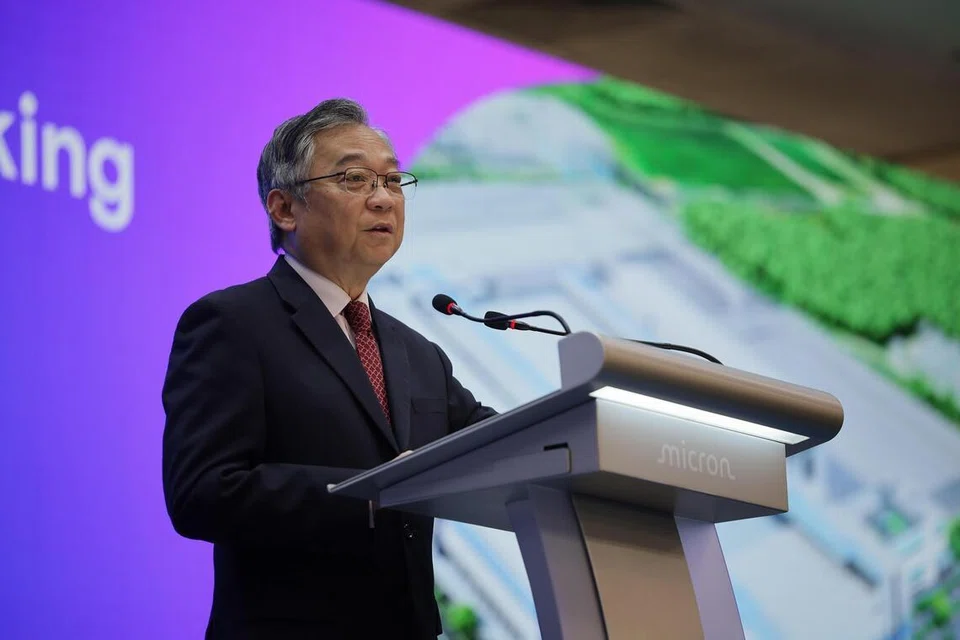
At the groundbreaking ceremony on Jan 27, Deputy Prime Minister and Minister for Trade and Industry Gan Kim Yong highlighted how geopolitical tensions, supply chain disruptions, and rapid technological change are reshaping global investment decisions. He said Micron’s new wafer fabrication facility strengthens Singapore’s role as a trusted hub for advanced manufacturing, allowing global firms to anchor critical operations with confidence despite volatile global conditions.
AI Shortages Drive Long-Term Contracts
Micron’s leadership underscored the unprecedented demand for memory chips driven by AI. President and chief executive Sanjay Mehrotra said memory and storage have become strategic assets enabling AI’s full potential, with shortages expected to persist beyond 2026. Executive vice-president of global operations Manish Bhatia added that Micron is currently meeting only about half to two-thirds of client demand, prompting customers to negotiate multi-year supply agreements instead of traditional one-year contracts.
Broader Economic Impact and SME Opportunities
Beyond large-scale manufacturing, Micron’s expansion is creating opportunities for local small and medium-sized enterprises. The company has collaborated with Singapore-based Techfox to deploy customized autonomous mobile robots integrated with smart factory systems. According to the Economic Development Board, Singapore contributes one in 10 chips globally and accounts for one-fifth of worldwide semiconductor equipment production, with the industry employing over 35,000 people and contributing nearly 7 percent to GDP.
Micron’s US$24 billion investment reflects how AI-driven demand is reshaping the global semiconductor landscape, with Singapore positioned as a strategic production and innovation hub. For Indonesia and Singapore alike, the expansion highlights the region’s growing importance in advanced technology supply chains, talent development, and long-term economic resilience.
Sources: Straits Times (2026) , Reuters (2026)
Keywords: Micron Technology, NAND Flash Memory, AI Chips, Singapore Semiconductor Industry, Data Centres


