


Nvidia partners with Oracle and the U.S. Department of Energy to build America’s largest AI supercomputers, securing the nation’s lead in scientific and defense innovation.
Nvidia, the global leader in artificial intelligence (AI) chips, announced plans to build seven next-generation AI supercomputers for the U.S. Department of Energy (DOE), further cementing its role at the heart of America’s technological infrastructure. CEO Jensen Huang unveiled the initiative during Nvidia’s GTC conference in Washington, D.C., highlighting the company’s expanding partnership with the federal government.
Building the Future of AI Power
During his keynote, Jensen Huang revealed that Nvidia will develop seven AI supercomputers across U.S. research facilities, including Argonne and Los Alamos National Laboratories. The initiative aims to strengthen America’s scientific and defense capabilities through advanced computing systems built with Nvidia’s latest Blackwell graphics processing units (GPUs).
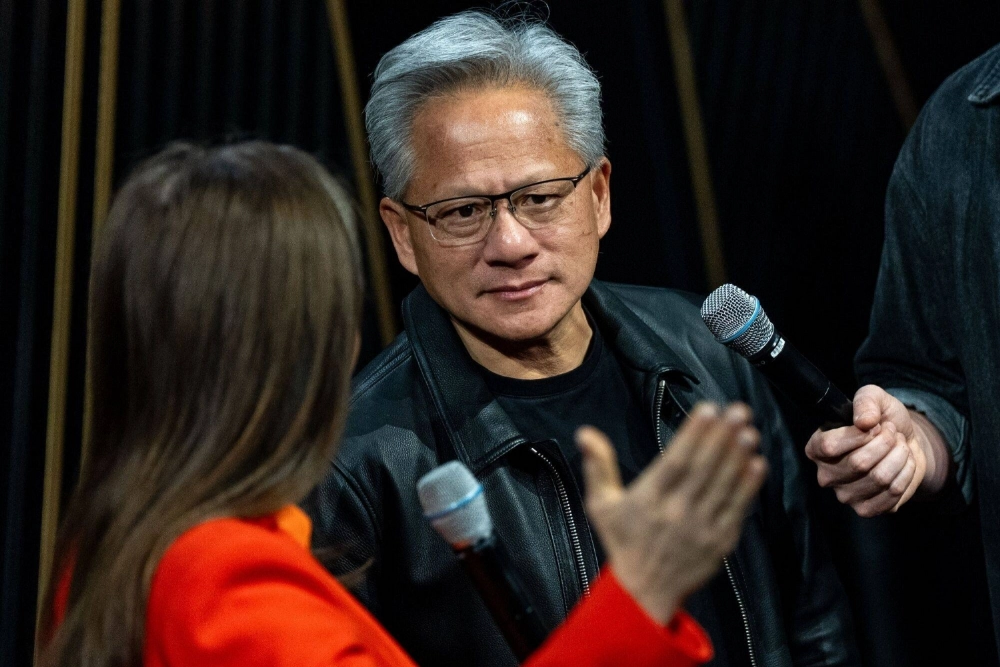
Nvidia CEO Jensen Huang. Credit: Bloomberg
The flagship system, Solstice, will become the DOE’s largest AI supercomputer. Built in partnership with Oracle, Solstice will contain 100,000 Nvidia Blackwell GPUs to power AI models supporting nuclear research, energy innovation, and national security applications. Another system, Equinox, equipped with 10,000 GPUs, is scheduled to go online in 2026.
“A Foundation for a Prosperous Future”
“The next wave of progress will be determined by our ability to scale AI infrastructure,” said Huang. “Together, with our partners, we are building the most advanced AI systems ever created, ensuring that America’s AI runs on innovation and openness — for the benefit of all.”
The announcement marks a milestone in Nvidia’s growing alignment with the U.S. government’s AI ambitions. The company’s GTC event, held for the first time in Washington, D.C., reflects its deepening presence in federal projects and defense-related research.
Partnerships Across Science and Industry
In addition to Solstice and Equinox, Argonne National Laboratory will host three Nvidia-based systems — Tara, Minerva, and Janus — supporting AI research and experimental science. At Los Alamos in New Mexico, Nvidia’s Vera Rubin platform will enhance computing systems known as Mission and Vision, built by Hewlett Packard Enterprise for the National Nuclear Security Administration.
DOE Secretary Chris Wright, who joined Huang at the conference, praised the collaboration: “For national security and prosperity, it’s critical that the United States lead in AI. That means new partnerships between government and industry — partnerships that move at the speed of business.”
Strategic Technology and Quantum Integration
Nvidia also unveiled NVQLink, a new tool enabling quantum processors to interface with at least eight U.S. supercomputing laboratories. This breakthrough will allow quantum and AI systems to work together, opening new frontiers in scientific discovery, from nuclear fusion to materials research.
Meanwhile, the DOE announced parallel partnerships with AMD and Hewlett Packard Enterprise (HPE) to build two additional AI supercomputers at Oak Ridge National Laboratory, signaling a broader national push toward high-performance computing dominance.
Expanding Commercial and Global Reach
Beyond government collaboration, Nvidia continues to expand its private-sector footprint. The company announced a $1 billion investment in Nokia for AI-driven telecommunications and introduced Arc, a new product line tailored for 6G base stations. It also revealed partnerships with Palantir Technologies and Uber, extending its AI expertise into logistics and autonomous mobility.
Nvidia currently holds $500 billion in chip bookings over the next five quarters — a figure that underscores both soaring global demand and its dominance in the AI hardware market.
Nvidia’s partnership with the U.S. Department of Energy represents more than a technological leap — it is a strategic investment in national resilience, innovation, and global competitiveness. By anchoring AI infrastructure in America’s scientific and defense institutions, Nvidia and its partners are laying the groundwork for an era where computation, security, and discovery move hand in hand.
Sources: Al Jazeera (2025) , FedScoop (2025)
Keywords: Nvidia, AI Supercomputers, Department of Energy, Oracle, Blackwell Chips, Jensen Huang, Quantum Computing


