


Enterprise Singapore opens BizAdapt Grant to help SMEs reconfigure supply chains amid global tariff tensions
Singapore businesses hit by US tariffs can now apply for financial support of up to $100,000 under a new government scheme aimed at boosting resilience and competitiveness in turbulent global trade conditions.
Helping Firms Adapt to a Shifting Trade Landscape
Enterprise Singapore launched the Business Adaptation Grant (BizAdapt) on October 7, offering up to $100,000 per company over two years to help local firms navigate the impact of tariffs introduced by US President Donald Trump. The initiative supports small and medium enterprises (SMEs) with up to 50 percent funding, while larger firms can claim 30 percent of eligible costs. Applications are open via the Business Grants Portal until October 6, 2027.
The grant comes as global trade faces renewed disruptions from US protectionist measures. The Singapore Economic Resilience Taskforce (SERT), chaired by Deputy Prime Minister Gan Kim Yong, first announced the measure in July to help companies “seize emerging opportunities” while mitigating tariff shocks.
Who Qualifies and What It Covers
Eligible firms must be registered and operating in Singapore, with at least 30 percent local equity held by Singapore citizens or permanent residents. Companies must also demonstrate that they export to or operate in overseas markets and have been affected by tariffs.
Businesses can use the funding to engage third-party advisory services in areas such as:
- Free Trade Agreements (FTA) and trade compliance assessments
- Legal and contractual advisory for reviewing and redrafting contracts
- Supply chain optimisation and market diversification strategies
Enterprise Singapore said these services would help companies diversify markets, strengthen compliance processes, and adjust production structures to remain competitive.
Real-World Applications and Impact
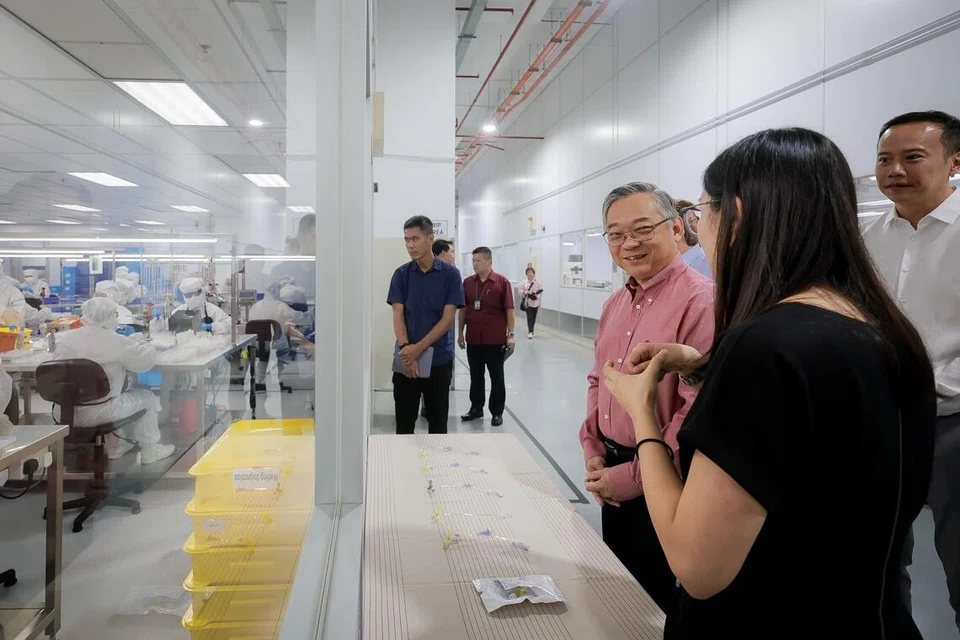
Medical device manufacturer ForeFront Medical Technology—with facilities in Singapore, China, the UK, and Mexico—was among the first to express interest in the grant. Its president, Walter Tarca, said the scheme’s supply chain reconfiguration component would be particularly helpful, as moving operations involves high compliance and validation costs.
“Shifting supply chains isn’t just about moving machines; compliance and revalidation make it very costly,” Mr Tarca said during DPM Gan’s visit to ForeFront’s Tuas facility. The company is expanding its cleanroom to handle new projects potentially relocating from other regions facing higher tariffs.
Broader Economic Implications
The US tariffs—set to include a 100 percent duty on branded pharmaceuticals—were initially scheduled for October 1 but have been temporarily deferred. Pharmaceuticals account for 13 percent of Singapore’s exports to the US, worth around S$4 billion annually.
“While the implementation has been delayed, we expect it to come into effect eventually,” DPM Gan said, noting that the government is closely monitoring the impact. “BizAdapt will help mitigate these pressures while positioning our companies to capture new opportunities.”
Continuous Support Under Review
DPM Gan emphasized that the grant may be extended depending on how global tariffs evolve. “Once the situation stabilizes, we may need to look at other schemes to support companies in the new environment,” he added.
Mark Lee, vice-chairman of the Singapore Business Federation, also praised the initiative, calling it “a timely buffer” for businesses navigating global uncertainty. “Every dollar counts in today’s volatile environment,” he said.
The BizAdapt Grant marks a crucial step in cushioning Singapore’s trade-dependent economy from escalating global tariffs while encouraging long-term resilience and innovation. For Indonesian and regional partners, it signals Singapore’s commitment to maintaining supply chain stability—an important assurance for cross-border manufacturers and exporters in an increasingly fragmented global market.
Sources: AsiaOne (2025) , Straits Times (2025)
Keywords: Business Adaptation Grant, US Tariffs, Enterprise Singapore, Gan Kim Yong, SMEs Support, Supply Chain Reconfiguration


