


As Myanmar reels from a deadly 7.7-magnitude quake, global aid pours in—except from the U.S. With over 4,400 dead and aftershocks shaking Bangkok, this in-depth report reveals how politics, science, and regional resilience are redefining disaster response across ASEAN.
As of April 3, 2025, Myanmar’s deadliest earthquake in over a century has left 4,430+ dead, 4,760+ injured, and 780+ missing, with Thailand reporting 36 fatalities and 18 buried in Bangkok’s collapsed high-rise. The 7.7-magnitude quake ruptured 460 km of the Sagaing Fault, unleashing 288 aftershocks—including a 6.7 tremor—that destabilized buildings as far as Ho Chi Minh City. While China and India race to deliver aid, the U.S. remains conspicuously absent, its disaster response gutted by Trump-era budget cuts.
1. Global Aid Mobilization: Beijing’s Blue Helmets, Washington’s Empty Chairs

China’s 100 million yuan ($13.76 million) aid package and 24/7 state media coverage have rebranded its image from junta collaborator to humanitarian hero. India deployed 625 tons of supplies and field hospitals to Mandalay, while Russia airlifted mobile medical units. Contrast this with the U.S., which offered a paltry $2 million and a three-member team stalled by visa delays—a shadow of its pre-Trump disaster response. The UN’s OCHA warns of cholera outbreaks in Myanmar as 13-hour treks through rubble replace eight-hour drives. Snarky take: When even Russia out-donates you, it’s time to audit Elon Musk’s “Government Efficiency” playbook.
2. Myanmar’s Political Quagmire: Junta vs. Reality
The military regime claims 3,000 deaths, while the opposition National Unity Government (NUG) estimates 8 million needing aid. Junta-controlled Mandalay receives 90% of supplies, while resistance-held Sagaing—home to 1.35 million displaced pre-quake—gets crumbs. The NUG’s two-week ceasefire with anti-junta militias highlights how even war zones prioritize disaster ethics over dictatorship. Meanwhile, state media ignores 700 Muslims crushed in collapsing mosques, a grim footnote in Myanmar’s sectarian strife.
3. Thailand’s Fragile Resilience: Condos Crack, Confidence Follows

Bangkok’s Chatuchak district collapse exposed lax enforcement of 2007 seismic codes, with 90% of pre-2007 high-rises deemed “earthquake-vulnerable”. The Bank of Thailand’s 31.4 billion baht condo glut now faces 15-year sales lows as buyers flee high-rises. Prime Minister Paetongtarn Shinawatra’s post-quake advice—“don’t panic or use elevators”—rings hollow when the State Audit Office building, a tax-funded project, pancaked. Snark level: Thai officials inspected two whole buildings, rated them “green,” and called it a day.
4. Bangkok’s Structural Anxiety: Developers Scramble, Buyers Bail
15 major developers—including Sansiri and AP Thailand—conducted emergency inspections, revealing cracks in Park Origin Thonglor and other luxury towers. Colliers Thailand predicts Q2 2025 condo sales will hit a 15-year low, cratering investor confidence. The Thai Condominium Association’s 19 billion baht Q3 2024 sales—already a 14-year worst—now look rosy. Takeaway: When your bridge connecting skyscrapers fails before occupancy, maybe don’t blame “supershear” science.
5. The Cholera Clock Ticks: Sanitation Collapse Looms
Myanmar’s 90% water infrastructure damage has OCHA prepping for outbreaks, with Mandalay General Hospital treating patients on sidewalks. The WHO’s 4,760+ injury tally excludes 1,200 crush syndrome cases needing dialysis—a luxury in junta-blocked regions. Meanwhile, Thailand’s insurance claim chatbots (@oicconnect) can’t mask the 24-hour wait times for adjusters. Pro tip: When your disaster app crashes faster than buildings, rethink “digital-first” triage.
6. Rebel Roads to Recovery: Militias Out-Rescue the Military

Ethnic militias in Shan and Kayin states—3.56 million displaced pre-quake—now lead rescue ops, using jungle routes to bypass junta checkpoints. The NUG’s crowdfunded field hospitals contrast with the military’s 403 rescues vs. 259 body recoveries in Mandalay. Snark: When your army spends more time looting than rescuing, it’s not a regime—it’s a racket.
7. Supershear Science: Why Bangkok Felt Mandalay’s Fury
The quake’s 4.3-meter slip along the Sagaing Fault generated supershear waves traveling 4.5 km/s, amplifying damage in Bangkok’s soft clay basins. Thailand’s 1997 seismic code proved theoretical as pre-2007 towers swayed like reeds, exposing a $33 billion property bubble. Lesson: When your building code is younger than TikTok, don’t skimp on enforcement.
8. Digital Lifelines: Fintech Fills Aid Voids
Malaysia’s parametric insurance payouts, triggered automatically by seismic data, delivered RM1.1 billion to SMEs via Sapura Energy’s blockchain platform. Thailand’s PromptPay and Singapore’s 5% dividend yields stabilized markets, while Indonesia’s rupiah crash worsened post-quake. Snark meter: If your e-banking survives a quake but your currency doesn’t, maybe hedge with gold.
9. The Geopolitical Aftershock: China’s “Humanitarian Corridor”
Beijing’s aid convoys traversing rebel-held Kachin signaled its sway over both junta and militias, rebooting Belt and Road deals paused since 2021. India’s Naypyidaw field hospital and Russia’s Yangon naval aid counterbalance ASEAN’s silence, while Trump’s USAID dismantling cedes soft power. Takeaway: When you defund diplomacy, you get a world where Xinhua out-reports CNN.
10. Lessons Unlearned: From Turkey to Myanmar
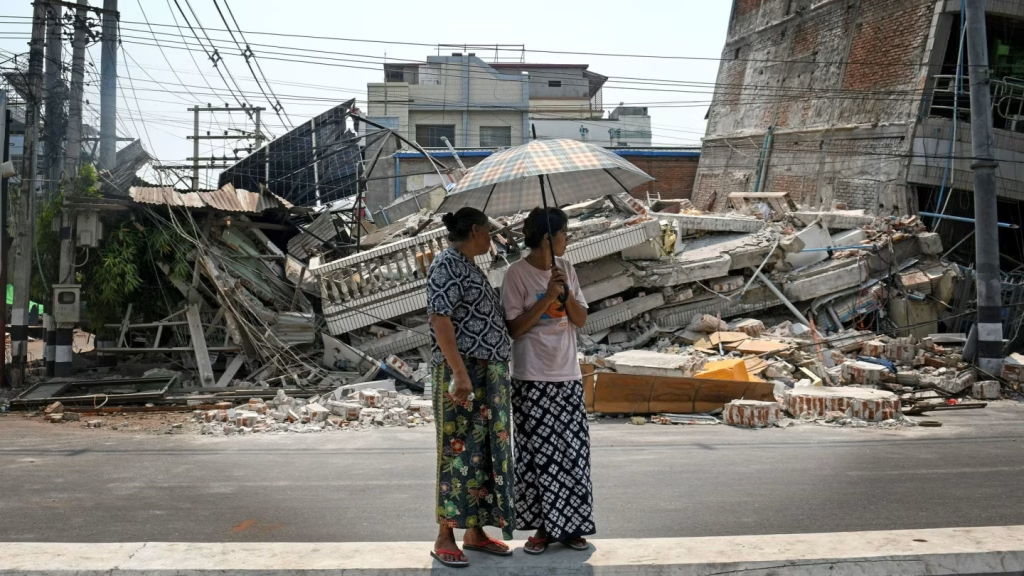
The 2023 Turkey-Syria quake taught us politicized aid kills; Myanmar repeats this with junta-blocked UN teams. Bangkok’s two “red zone” buildings—still unnamed—prove audits without accountability are theater. Meanwhile, Singapore’s 2.6% GDP growth and Malaysia’s flood-ready fintech offer resilience blueprints.
What It Means for Global Investors and ASEAN
For Singapore, 5% dividend yields in REITs and banks offset regional risks, while Malaysia’s DITO insurance framework and Indonesia’s rupiah rescue demand caution. Investors eyeing Thailand’s $31.4 billion condo glut should wait for post-2007 builds—or buy land. As Myanmar’s junta peddles “reconstruction contracts,” remember: In disaster capitalism, the vultures arrive before the medics.
Sources:
[1] 2025 Myanmar earthquake – Wikipedia
[2] Myanmar earthquake: What we know – BBC
[3] 2025 Myanmar and Thailand Earthquake
[4] Aid efforts intensify after deadly Myanmar-Thailand quake
[5] 288 aftershocks registered since Friday’s earthquake in Myanmar
[6] Unprepared for disasters


