


Transparency International praises governance strength while flagging growing risks of cross-border money laundering
Singapore’s reputation for clean governance remains intact on the global stage, but new findings show that even top performers are not immune to evolving corruption risks in an increasingly complex financial world.
Singapore Maintains Top Global Standing
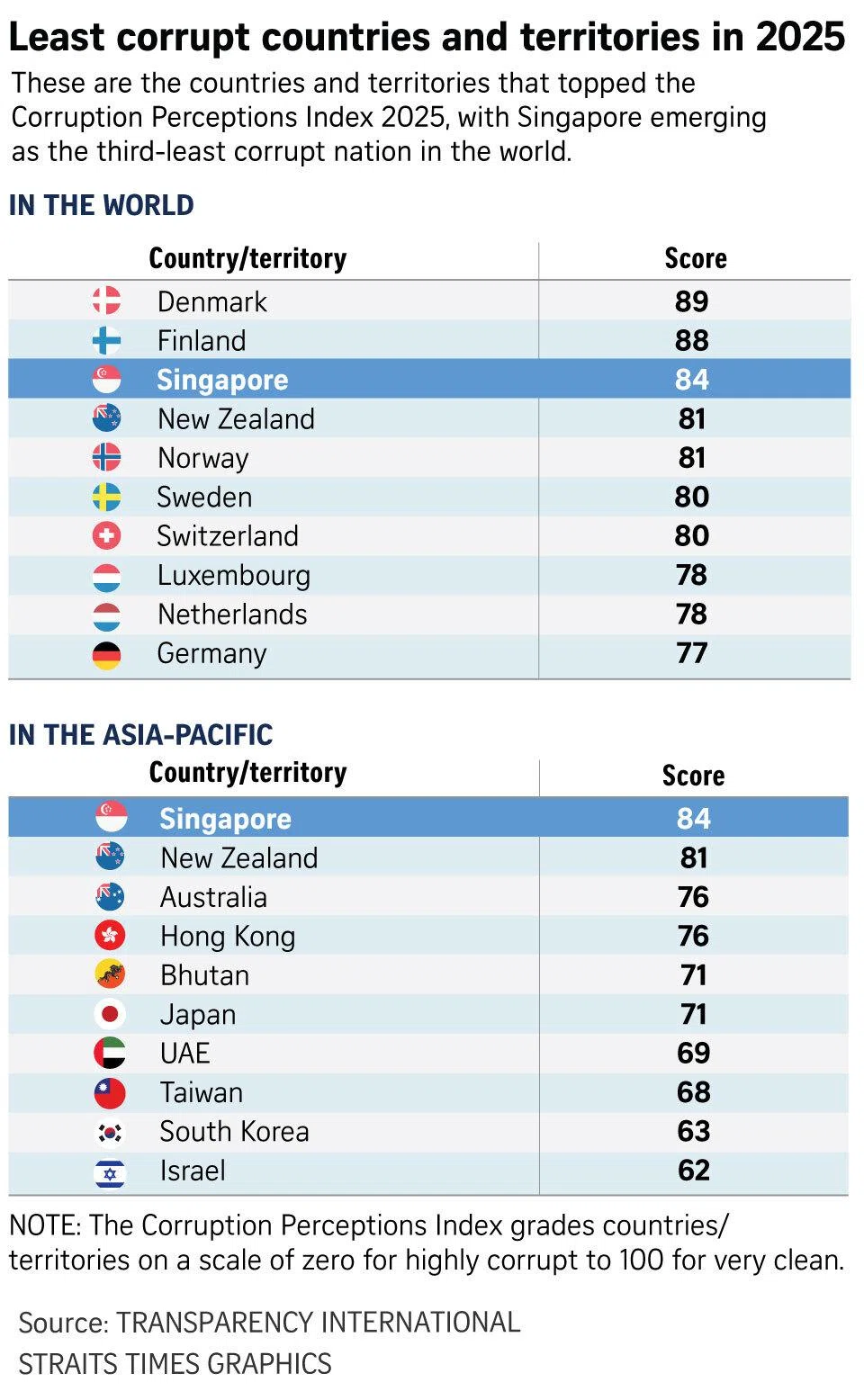
Singapore emerged once again as the least corrupt country in the Asia-Pacific region in 2025 and the third least corrupt globally, according to Transparency International’s Corruption Perceptions Index released on Feb 10. The Republic scored 84 out of 100, reaffirming its position among the world’s cleanest governments for a second consecutive year.
Strong Scores Amid Global Decline
The CPI assessed 182 countries and territories based on perceived public-sector corruption. Denmark topped the index with a score of 89, followed by Finland at 88, Singapore at 84, and New Zealand at 81. Globally, corruption worsened, with the average score slipping from 43 to 42 in 2025, and more than two-thirds of countries scoring below 50, including Indonesia at 34 and Thailand at 33.
Enforcement and Zero Tolerance Culture
Singapore’s Corrupt Practices Investigation Bureau attributed the strong performance to robust legislation, effective enforcement, and public vigilance. The agency emphasized that zero tolerance toward corruption and collective accountability remain central to Singapore’s long-standing credibility and trustworthiness.
Scrutiny Over Dirty Money Flows
Despite its high ranking, Transparency International cautioned that top CPI scores do not guarantee corruption-free systems. Singapore was cited alongside Switzerland for facing scrutiny over facilitating the movement of illicit funds across borders, an issue not directly captured in CPI scoring.
High-Profile Money Laundering Case
Concerns intensified following a major enforcement action in October 2025, when Singapore authorities seized and restricted financial assets and properties worth over $150 million linked to Cambodian businessman Chen Zhi and Prince Group. The move followed sanctions by US and UK authorities over alleged money laundering, wire fraud, and forced-labor scam operations in Cambodia. Chen was later arrested and deported to China on Jan 6.
The Risk of “Singapore-Washing”
Legal experts warn that Singapore’s clean image and ease of doing business can be exploited by bad actors seeking legitimacy. Wilson Ang of Norton Rose Fulbright noted that some companies rely on Singapore incorporation to mask illegal activities, a practice sometimes referred to as “Singapore-washing.”
Calls for Legal and Regulatory Updates
Experts say Singapore may need to further strengthen laws on bribery, whistle-blowing, corporate liability, and financial oversight. With the rise of fintech firms, payment service providers, and cryptocurrency platforms, regulators are urged to expand safeguards beyond traditional banks and deepen cross-border cooperation to curb illicit financial flows.
Singapore’s consistent top-tier ranking reinforces its standing as a global benchmark for clean governance, but the evolving nature of financial crime presents fresh challenges. As corruption worsens worldwide, the Republic’s ability to adapt its legal and regulatory framework will shape not only domestic trust, but also confidence among regional partners, including Indonesia and Singapore’s wider Asia-Pacific counterparts.
Sources: Straits Times (2026) , EN Tempo (2026)
Keywords: Singapore Corruption Ranking, Transparency International CPI, Money Laundering Risks, Asia Pacific Governance


